
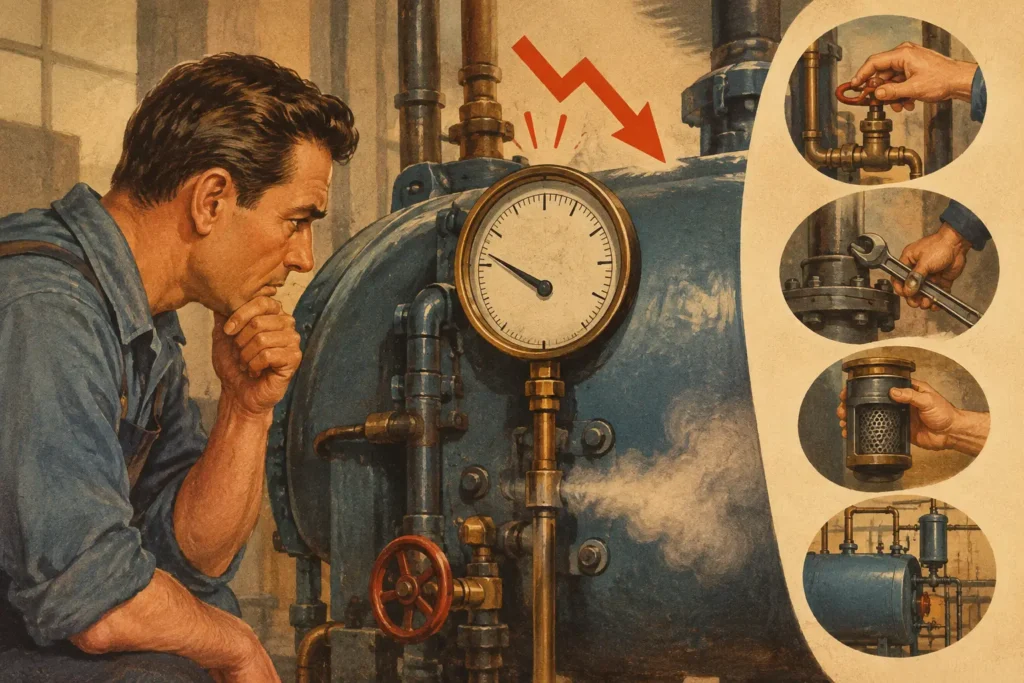
A boiler pressure gauge slipping below its usual level can be easy to miss until the heating stops working or a fault code appears. If you are wondering why boiler pressure drops, the short answer is that water has left the sealed heating system – but the reason it has happened can range from a normal recent radiator bleed to a fault that needs an engineer.
A small change is not always a crisis. Repeated pressure loss, however, is a sign worth acting on. Catching it early can help avoid a cold home, an inconvenient breakdown or a more costly repair later on.
What boiler pressure should be
Most modern combi and system boilers work on a sealed system. When the heating is cold, the pressure gauge will usually sit between 1 and 1.5 bar. Once the heating is running, the pressure normally rises a little because the water expands as it warms up.
Your boiler handbook gives the exact recommendation for your model, so use that as your starting point. As a general rule, pressure below 1 bar may cause the boiler to stop or show a low-pressure warning. If it regularly climbs towards 2.5 or 3 bar when the heating is on, that can point to a separate issue with the expansion vessel or pressure relief valve.
The key question is not simply whether the gauge is low today. It is whether you have topped it up once after a known event, or whether it keeps falling again over days or weeks.
Why boiler pressure drops in a sealed system
You have recently bled a radiator
Bleeding a radiator releases trapped air so heat can circulate properly. It can also release a small amount of water, which lowers system pressure. In this case, repressurising the boiler afterwards is usually expected.
Check the radiator valves are closed properly once you have finished. A slow drip from the bleed point can continue to reduce pressure over time.
There is a leak somewhere in the heating system
A leak is one of the most common reasons for ongoing pressure loss. It may be visible around a radiator valve, towel rail, pipe joint or beneath the boiler. You might spot a damp patch, staining, corrosion or a small pool of water.
Not every leak is obvious. Pipework can run beneath floors, behind boxing or inside walls, particularly in older homes and rental properties that have been altered over time. That is why a boiler that needs topping up repeatedly should not be treated as a simple routine job.
The pressure relief valve is letting water out
The pressure relief valve is a safety feature. It releases water through a copper pipe, usually on an outside wall, if the boiler pressure becomes too high. If the valve does not close fully afterwards, water can continue to escape and the pressure will gradually drop.
Look at the end of the external copper pipe when the boiler is cool. If it is wet, dripping or leaving regular puddles, tell your heating engineer. Do not block or cap this pipe – it is there for safety.
The expansion vessel needs attention
Inside the boiler is an expansion vessel, which takes up the extra volume created as heating water gets hot. If it loses its charge or its internal diaphragm fails, boiler pressure may rise sharply while the heating is on. The pressure relief valve then releases water, and the gauge can be low again once everything cools down.
This pattern is particularly useful to note: normal or low pressure when cold, a big jump when hot, then pressure loss afterwards. An engineer can test and repair the issue safely. It is not a DIY job.
A boiler component is leaking internally
Over time, seals, pumps, heat exchangers and other internal components can develop faults. Some internal leaks are small and may not be immediately visible from outside the boiler casing.
Never take the casing off to investigate. Boilers should only be opened and repaired by a Gas Safe registered engineer. Apart from the safety risk, opening the appliance can make a fault harder to diagnose and may affect any warranty or service agreement.
The filling loop has been left open or is faulty
The filling loop is used to add water and bring pressure back up. Once the correct level is reached, it should be shut off as instructed in your boiler manual. A problem with the filling arrangement can lead to pressure behaving unpredictably, including a rise that causes the pressure relief valve to discharge water.
It is worth checking that any accessible valves are fully closed, but avoid forcing stiff valves or repeatedly adjusting parts you are unsure about.
Safe checks you can make at home
Before booking a repair, a few straightforward checks can help explain what is happening. Start by looking at the pressure gauge when the boiler and radiators are cold. Make a note of the reading, then check it again after the heating has been running for an hour. This gives an engineer a clearer picture than a single reading.
Next, inspect visible radiator valves, radiator bleed screws and pipe joints for moisture or rust marks. Check beneath the boiler without removing its cover, and inspect the end of the external pressure relief pipe for drips.
If you have recently bled radiators and there are no signs of a leak, you may be able to repressurise the system using the filling loop instructions for your specific boiler. Add water slowly and stop at the recommended cold pressure, normally around 1 to 1.5 bar. Then close the valves securely.
Do not keep topping up a boiler that loses pressure again. Fresh water introduces oxygen and minerals into the system, which can contribute to corrosion over time. Repeatedly repressurising may get the heating going temporarily, but it does not fix the cause.
When to call a heating engineer
Arrange professional help if the pressure falls again after you have topped it up, if you can see water leaking, or if the boiler displays a fault code. You should also call an engineer if pressure rises dramatically whenever the heating comes on, or if the pressure relief pipe is regularly dripping.
Turn the boiler off and seek urgent help if you notice a strong smell of gas, feel unwell with symptoms such as dizziness or nausea, or your carbon monoxide alarm sounds. Leave the property if necessary and follow the emergency instructions provided by your gas supplier. A water leak close to electrical wiring, sockets or consumer units also needs prompt attention.
For tenants, report pressure problems to your landlord or managing agent as soon as you notice them. Taking a dated photo of the gauge and any visible leak can make the issue easier to explain. Landlords should treat recurring pressure loss as a maintenance concern rather than asking tenants to keep refilling the system.
How to reduce the chance of pressure problems
Some causes cannot be prevented entirely, especially as boilers and heating components age. Regular servicing does give an engineer the opportunity to check the boiler’s condition, safety controls and signs of developing faults before a minor issue becomes a no-heating call-out.
It also helps to use radiator bleed valves carefully, check the pressure after bleeding, and deal with small drips promptly. If a radiator takes a long time to warm up, has cold patches or needs frequent bleeding, mention it during a service rather than waiting for the system to stop.
For homeowners and landlords across West Yorkshire, a maintenance plan can make these problems far less stressful. No Hassle Heating provides practical support for boiler and heating breakdowns, with qualified help available when a pressure issue needs more than a quick check.
A pressure gauge is a small detail, but it tells you a lot about the health of your heating system. Check it occasionally when the boiler is cold, act on repeated changes, and let a qualified engineer find the cause before the next cold morning does it for you.
